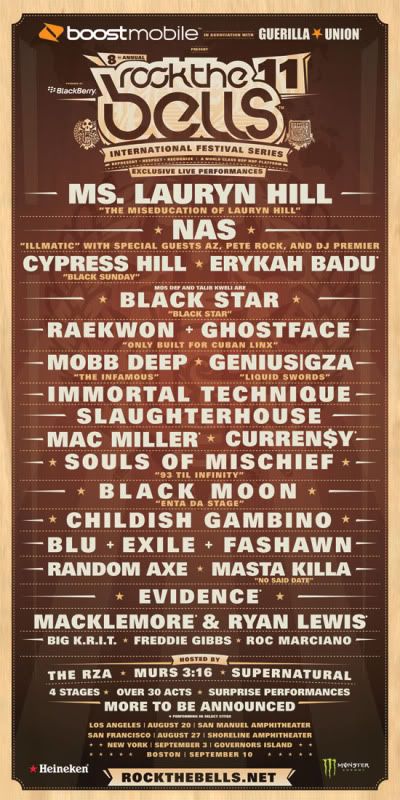
"Yall Ready for Nas_
Yall Ready to See Nasty Nas?"
The Q.B. King of lyrical flow, content, & consciousness is back on to "something"? This is a flip for his regular fan base, slash_ followers, who might not be as much in love with 'the truth', and honest enough to say 'Welcome back' 'Nasty' Nas, where've you been? Taking a shot, a good guess is- he's been committed to loving 'the truth', and living the Great Mystery.
Remember, "Nas' is half man, half amazing!" As he's dealt with his trying marriage, birth, family issues, tours with Damien Marley and limited hype, slash_ tracks, it is apparent that Nasty Nas' hiatus worked better than an effective placebo. His new release 'Nasty' is 'the truth' .
"The Ideology is Confusion"
Respect the game with the understanding that it's life.
banner


Thursday, June 16, 2011


Friday, June 10, 2011
The Simply Complicated

It was as if seeds bearing blood had penetrated deep within the earth’s soil that bloomed electric forces; “Flower power”, Jimi Hendrix and Miles Davis continued to propagate the “process of liberation” into the next decade. 
The period was bursting with violence, war and destruction that would forever stain the common fabrics of U.S. American “normality”. The prominent jazz bass “virtuoso”, Charles Mingus once said that “anyone can make the simple complicated. Creativity is making the complicated simple.” One of United States history’s most significant decades, the 1960’s, can “simply” be described as a time of complication.
 Racial and economic classifications and other social concepts were on the cusp of societal and political divergence. People were on either side united in opposing groups. These modern phenomena brought about the avant-garde jazz sounds of “free-tonality”. The sonic intensity dynamically absorbed the nation; free-jazz was selflessly filling the emptiness in the people attached to the array of social turmoil current in the U.S. It was a platform that made room for common grounds. Musicians Charles Mingus, John Coltrane, Archie Shepp, Art Blakey, Ornete Coleman, and other 1960’s jazz greats creatively manipulated the nation’s international “ugliness” and made it attractive. “Free-jazz is an illusion” neither simple nor complicated, beats forged pulses and rhythms evolved into “free-playing”.
 “Free-jazz” was introduced to the world in the 1960’s. “The style must be listened to without this need for self-affirmation. The music does not follow the listener anymore; the listener must follow the music. They transposed in off-pattern dynamics that overshadowed, the traditional European-fashioned ways of playing and listening to music. “Leading jazz musicians claimed an affinity between their music and radical politics; […] ‘new thing’, ‘free jazz’, ‘energy music’ – suggested revolutionary hopes”.

1950’s be-bop musician, trumpeter Miles Davis, was a trend-setter on the “smooth” jazz scene (“smooth” refers to the mellow mood quality of that particular jazz sound); until the turn of the century when society’s visions and creative expressions collided. Jazz and society were at a stage of freedom. “The people” moved in a “by any means necessary”, very avant-garde tenor. The “charlatans” swung in harmony with the movement. A screaming manifestation of sounds surged throughout the world. The music was an expression of the causes and effects extant during a decade bearing turbulent environments. “Musicians play because of the world around them and what goes on […], and don’t forget there was a lot of violence in the 60’s.”
 As jazz musicians moved further away from composing European-style quality tunes, many also began finding double standards in the European derived Christian religion. “Whoever wishes to become a truly moral human being must first divorce himself from all the prohibitions, crimes, and hypocrisies of the Christian church.” Yusef Lateef, Ornette Coleman, John Coltrane and Art Blakey are among some of the jazz musicians who began to embrace Islam.
 The Muslim religion sparked their fascination with Arabic and Indian music. Jazz music adopted traditional elements from a panorama of worldly ingredients. This convergence of “spiritual unity to complete communion and communication with the globe as a unity- and, through that, love, and peace for everybody and salvation in pan-religious ecstasy… cosmic ascension and elation to mythological suns and nebulae and heliocentric worlds” expanded the fields.

Ornette Coleman made Peace in 1959. John Coltrane introduced A Love Supreme in 1965. Yusef Lateef blended Japanese, Chinese and Egyptian elements to play the blues, producing a record titled The Golden Flute; A flat, G flat, and C in 1966. In this piece, Lateefs’ flute dances over the raga like a charmer entices his cobra to dance out of a basket. Miles Davis worked with Herbie Hancock and Chick Corea to record Filles de Kilimanjaro in 1968. All of these works were designed using the essentials of the world harmony, “free-jazz” approach.
The influential acoustics during the 1960’s included powerful voices. President John F. Kennedy, Medgar Evers, Malcom X, and Dr. Martin Luther King Jr. publicly addressed social injustices and lead in the call for equality and civil rights for all humankind universally. Their calls were answered to by rallying allies as well as assassins. In 1970 improvised electronics blended with rock rhythms and pitched “Fusion or jazz-rock”.

It was a new approach to the musical abstract, as theoretical as the ensuing Vietnam War. It was as if seeds bearing blood had penetrated deep within the earth’s soil that bloomed electric forces; “Flower power”, Jimi Hendrix and Miles Davis continued to propagate the “process of liberation” into the next decade.
Thursday, June 9, 2011
In An Arts Essence~ Off of Jamaica Ave.

‘Spit Fiya’, presented by Samantha Inniss and Jessie ‘Cypha’ Bowers was held at a petite art gallery. Cypha, curator a Gallery 161, measured it up as being the “forefront of the community.” The venue, shadowed by menageries of commercial, wholesale, retail and front rented structures, regularly acts as an outlet of creative expression for the arts.
Outside of the gallery there was a convergence of enthusiasts chitchatting up aural ingredients from “back in the days” to “sugar loaded cereal boxes” which included enticing toys. Polite tones echoed “to lure children into a lifestyle of poor eating habits,” from a dread brother supporting a cased instrument on his back. As his wise, geeky pitch subconsciously rose to compete with the passing car vibrations of Rick Ross, we laughed. “Child stuffing McDonald’s fries,” he commented, made no ‘picture perfect’ sense but witted those listening.
On the inside, colorful trays of fruit, vegetables, and little pinwheel sandwiches were sold for donation prices. Water, wine, and a sparkling beverage called ‘Izze’ balanced the ambiance; adding to the nature of the night. Attire was casual and more or less your trendy, ‘Urban Outfitter’ with a shot of extra soul. Hip-hop cultured high-top ‘Gumby’s’, locks, ‘fro-hawks’, and low-fades flavored the artists personalities.
African-American modern-folk art colored the white spaces of the illumined wall. The artist, Kareem ‘Inf’ Hayes showcased his paintings depicting faces, bodies, earth, wind, flames, graves, skeletons and serpents. In the midst of a rich, black, grave background stood a rich dark brown Soul mother carrying implicit notice. ‘Inf’ did not attend but visually his statement was silently telling.
Poets and lyricists with bars and beats, left the audience fully “plugged in and tuned out,” as in one of the hooks of closing feature performer and artist ‘Sosoon’.
Poets and lyricists with bars and beats, left the audience fully “plugged in and tuned out,” as in one of the hooks of closing feature performer and artist ‘Sosoon’.
19 year old Taylor Pickett-Stokes introduced a spontaneous stage name ‘Soulful T’, upon her unexpected opening performance. She kicked two acapella verses of Jill Scott’s ‘A Long Walk’ before an unanticipated poem fluidly drew listeners closer to her emotions.

“Who I used to be… caused me to go blind every day,” Soulful T harmoniously expressed. The man portrayed in the framed portrait on the wall sat right to the rear peripheral of her vocal release. The audience faced the flames of passion that abstracted the anonymous man in the relative painting.
Feature performer, Element an Apollo Finalist, poet and artist with the Nuyorican Poet’s Café “went in”. His polished lines were as clean as his sharp cut, suited look. However, he got dirty when he spoke of the ‘South Jamaica Aphrodisiac’, where he referred to HIV and himself as “a condom in reverse.” With sex ad’s avidly running wild and cigarettes being New York City’s new expressive assault, his poem promoting safe sex lit on a topic that momentarily has become a 'V', for “vintage” faction.
“Who I used to be… caused me to go blind every day,” Soulful T harmoniously expressed. The man portrayed in the framed portrait on the wall sat right to the rear peripheral of her vocal release. The audience faced the flames of passion that abstracted the anonymous man in the relative painting.
Feature performer, Element an Apollo Finalist, poet and artist with the Nuyorican Poet’s Café “went in”. His polished lines were as clean as his sharp cut, suited look. However, he got dirty when he spoke of the ‘South Jamaica Aphrodisiac’, where he referred to HIV and himself as “a condom in reverse.” With sex ad’s avidly running wild and cigarettes being New York City’s new expressive assault, his poem promoting safe sex lit on a topic that momentarily has become a 'V', for “vintage” faction.
“Support and show love,” Cypha urged the attendees to continue supporting the creative arts and music in Jamaica, Queens. He brought notice to its going through a commercial metamorphosis’. Applebee’s may be the first sign of this “new and improved” downtown tang. However, “we are the geniuses,” he stated, “realize that they come into the hood to copy write our styles.” On Thursday, June 9, 2011 ‘Private Beauty’, by Jocelyn M. Goode, “a new series of nudes on paper” will be premiered at Gallery 161.
Poet, Chris Slaughter asked in one of his poems, “when is it ever okay to live invisible?” His prose in perpetual motion led to the direction of responding “never!” Staying involved with the children, creative expression and the community is always a good way to penetrate positive social awareness.
Friday, June 3, 2011

Saturday, May 28, 2011

Gil Scot Heron Dies at 62

Gil Scot-Heron was born Gilbert Heron in Chicago. At the age of 18, he recorded his first album 'Small Talk at 125th and Lenox', where he performs spoken word poetry to congas and bongos. In 1974, his compilation album incluing the song 'The Revolution Will Not Be Televised' became one of his greatest works.
He passed away at a New York hospital Friday afternoon, according to his publicist report with CNN. The cause of his death has not be clear. However, he has struggled with drug addiction and was HIV positive.
The Revolution Will Not Be Televised
"You will not be able to stay home, brother./You will not be able to plug in, turn on and cop out./You will not be able to lose yourself on skag and skip,/Skip out for beer during commercials,/Because the revolution will not be televised." — Gil Scott-Heron
Friday, May 27, 2011
Subscribe to:
Posts (Atom)